Hint: It’s Not Just Generating Sales
A guide on how to give your selected channels a job to complete along with expectations
We Dug Into the Archives—And What We Found Still Holds True in 2025
Despite everything that’s happened since 2017—the rise of TikTok, the explosion of short-form video, and yes, the pandemic—the emotional foundations of media channels haven’t shifted as much as we think.
We went back to a pre-COVID study that measured how different platforms impact us emotionally. TV, online, mobile—each left a unique psychological footprint.
And here’s the surprising part:
When we conduct target group analysis today, the core emotional reactions still match up.
Sure, new formats have emerged. But the job of each channel during a campaign? Still remarkably familiar. So before we default to “every channel drives sales,” let’s pause and ask ourselves:
What role should each channel play in your strategy?
Because great results aren’t just about reach or impressions.
They’re about setting the right expectations from the start.
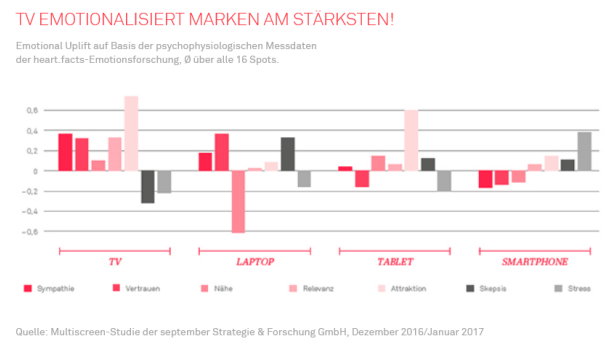
A 2017 study by CreaCompass and IP Deutschland used psychophysiological data to track how people feel when exposed to brand content across TV, online, and mobile. Multiscreening.
Spoiler: Not all channels are equal—and they shouldn’t be treated that way.
Fast forward to today:
Even with all the digital evolution, we see the same emotional roles in campaign performance.
So let’s break it down.
TV: The Trust Builder
- Highest impact on appeal, sympathy, trust, and relevance
- Low stress and scepticism
TV still owns the upper funnel.
It helps people feel something.
It creates space for stories.
Not noise—presence.
Online: The Explorer’s Stop
- Moderate uplift in appeal and trust
- Sharp drop in closeness
- Slight increase in scepticism
Online isn’t where relationships start.
It’s where they deepen.
Think mid-funnel: answer questions, offer options, validate interest.
Mobile: The Trigger Zone
- Lowest emotional uplift
- Highest stress
- Slight increase in scepticism
Mobile is where interruptions live.
But it’s also where actions happen—fast.
Perfect for nudging behavior, not nurturing connection.
Here’s the point:
Treating every channel like a direct-sales tool is a waste of potential.
Channels aren’t competitors. They’re instruments.
And great strategy? It’s a symphony.
- TV introduces.
- Online informs.
- Mobile activates.
The magic happens when you orchestrate all three with intention.
So, here’s a challenge:
What’s the job of each channel in your plan?
Not just “drive revenue”—but how? When? Why?
Because when planning is done right, execution becomes obvious.
And the brand doesn’t just show up—it performs.
Get in touch if you want to bounce some ideas in your media mix 🙂