And TV Is Still the Biggest Screen in the Room.

by Eric Vissers
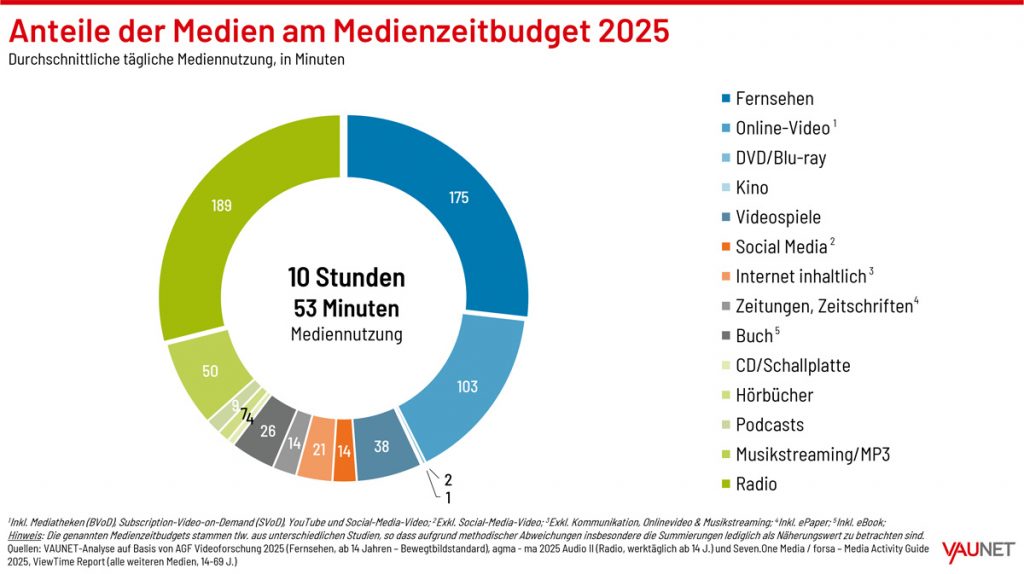
The VAUNET just dropped their 2025 media usage analysis (here in German). The headline everyone will run with: “TV is losing.” The number nobody will talk about: 10 hours and 53 minutes.
That’s how much time the average German spent consuming media every day last year. Per day. Seriously, let that sink in.
And 88.5% of that time went to audio and audiovisual content. Not text. Not social feeds. Sound and moving images.
So before we write the DEATH OF LINEAR TV (again), let’s look at what actually happened.
What the numbers say
TV viewing dropped from 3 hours and 8 minutes to 2 hours and 55 minutes daily. That’s 13 minutes less. Not great, not catastrophic.
Online video grew from 1 hour 38 minutes to 1 hour 43 minutes. Five minutes more.
Radio actually gained 6 minutes, now sitting at 3 hours and 9 minutes per weekday.
Music streaming stayed flat at 50 minutes. Podcasts even lost a minute, down to 9.
Video games held steady at 38 minutes.
What the numbers actually mean
The total pie didn’t shrink. People didn’t suddenly stop consuming media. They just shifted a few minutes from one plate to another.
TV lost 13 minutes. Online video gained 5. That’s not a revolution. That’s a slow drip.
And here’s the part that matters for anyone spending ad budgets: 2 hours and 55 minutes of daily TV consumption is still massive. It’s still the single largest chunk of video time. Online video at 1 hour and 43 minutes isn’t even close.
Combined, Germans spent 5 hours and 19 minutes WATCHING MOVING IMAGES every day. More than five hours of video attention, available every single day.
The real shift still isn’t what you think
The story isn’t “TV vs. Digital.” The story is that screen time is enormous and growing more fragmented.
The challenge for advertisers isn’t that audiences disappeared. They didn’t. The challenge is that the same person now splits their attention across more touchpoints.
That’s not a problem. That’s an opportunity…if you plan for it.
A brand that shows up on linear TV for broad reach, reinforces the message through CTV for precision targeting, and captures demand through search when intent spikes that brand wins (check out our Q5 report of 2025 and 2026). Not the one that panics and pulls TV budgets because of a 13-minute decline.
The audio blindspot
One thing that deserves more attention: radio at 3 hours and 9 minutes is the single most consumed medium in Germany. More than TV. More than streaming. More than anything.
Yet it barely gets a mention in most media plans.
Radio isn’t sexy. It doesn’t have a dashboard with real-time metrics. But 3 hours of daily attention is 3 hours of daily attention. At a fraction of the CPM.
The takeaway
Media consumption in Germany isn’t declining. It’s redistributing. The brands that will grow are the ones that follow attention and not headlines.
TV is not dying. It’s evolving again. And 2 hours and 55 minutes of daily reach is something most digital channels can only dream of.
The question isn’t whether to invest in TV. The question is whether your media mix reflects where attention actually lives.
Almost 11 hours a day. That’s not a shrinking market. That’s a MASSIVE opportunity hiding in plain sight.
Source: VAUNET Mediennutzungsanalyse 2025, based on data from agma, AGF, VuMA, Media Activity Guide, and ViewTime Report (Seven.One Media/forsa).