Your creative looks good on your monitor. But does it work on the street?
Every OOH creative goes through the same journey. It starts as a brief. It gets refined in a design tool. It gets approved in a meeting room: on a laptop screen, in good lighting, by people who have been staring at it for days.
And then it hits the street. Where no one has context. Where attention lasts seconds. Where your poster is competing with traffic, noise, other campaigns, and everything else happening in a person’s day.
The meeting room and the street are two completely different environments. A creative that looks clean on a laptop can get completely lost on a billboard. A message that seemed obvious in the deck can disappear when it’s surrounded by the visual noise of a city.
The problem is that most creative validation still happens in the meeting room. And by the time you find out it doesn’t work on the street, the campaign has already run.
That’s exactly the gap AI-powered creative heatmaps are built to close.

Why traditional pre-testing doesn't solve this
Most OOH pre-testing is either too expensive, too slow, or too removed from reality.
Running multiple versions of an ad across different locations to compare real-world performance isn’t feasible for most advertisers. So in the end, a lot of OOH creatives go live without any proper validation beyond internal sign-off.
What heatmaps actually do
Creative heatmaps bring the street into the meeting room.
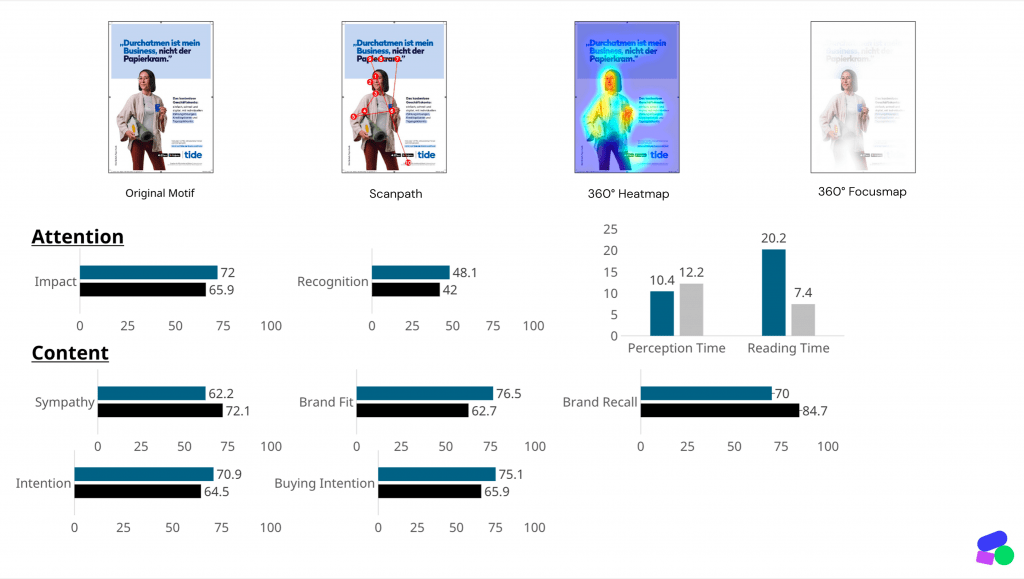
They combine eye-tracking methodology with AI to simulate where a viewer’s attention actually goes when they look at your ad. Not where you want it to go. Where it actually goes, in the first seconds of real-world exposure.
Current AI eye-tracking tools can model human gaze behaviour with up to 90% accuracy. That’s reliable enough to make better decisions: where to place your logo, how prominent your CTA needs to be, whether your headline is competing with a visual element for attention (and losing).
The output isn’t a gut feeling or a room full of opinions. It’s a heatmap that shows you exactly which parts of your creative capture attention first, and which parts get ignored entirely. That’s information you can act on before the campaign goes live.
What you can actually optimise
A few things heatmaps are particularly good at catching:
Messaging hierarchy: Is your primary message landing before anything else? Or is a visual element pulling focus away from the copy that actually needs to be read?
Logo visibility: In a brand campaign, you need the logo to register. Heatmaps tell you whether it’s getting the attention share it needs.
Format-specific behaviour: A poster at a bus stop behaves differently from a billboard on a motorway. Dwell time changes everything. Formats in high-dwell environments like trains or metro stations can carry more visual complexity. Formats seen at speed need ruthless simplicity. Heatmaps help you calibrate for each.
Human gaze dynamics: People are hardwired to look at faces and to follow the direction of someone else’s gaze. Placing a figure who looks toward your CTA or key message is a simple technique that consistently moves attention in the right direction. Heatmaps confirm whether it’s working.
A/B testing before you spend
One of the more underused applications is running A/B comparisons on creative variations before committing to a buy.
Two versions of the same ad: slightly different logo size, different image crop, different text placement. Heatmaps give you a data-backed reason to choose one over the other, rather than defaulting to whoever has the strongest opinion in the room.
For a brand campaign, you might want 60% of visual attention on the logo. For a performance-oriented OOH execution, you need the CTA to be impossible to miss. Heatmaps let you verify that those goals are actually being met by the design.
What heatmaps aren't
They’re not a replacement for good design thinking.
A heatmap won’t tell you if your concept is compelling, if your message is relevant to your audience, or if your brand is showing up in the right context.
What heatmaps do is validate the execution of a design decision that’s already been made. They give you a way to stress-test the creative against how real attention actually works, before it meets the street. That’s a more modest claim but a useful one, especially when significant media investment is riding on creative that’s never left the room.
The bigger picture
AI eye-tracking is still developing. The tools are getting more sophisticated, the data more granular, and the integration with broader neuromarketing research more robust. What’s already possible is useful enough to change how OOH creative gets validated. What’s coming will likely influence digital UX, web design, and visual communication more broadly.
For now, the practical takeaway is this: the meeting room will always be where creative gets made. Heatmaps are how you make sure it’s ready for everything outside of it.
Want to know how we use creative heatmaps in our OOH planning process?